
For over a decade the Library has hosted a variety of exhibitions, 34 in total, drawing objects from its own collections.
The subjects ranged from the beautiful, extraordinary, unknown, interesting to the thought-provoking.
In this temporary exhibition some of the works that were on display in the past decade have returned.
We have highlighted different objects represented in our collections: marbled papers, gems, prints, medals and medieval bronze bells.
We have also displayed some of the books that have evoked surprise and awe amongst our visitors during past exhibitions.
2014 | Marbled Papers
Paper marbling is a method of decorating paper with an ink pattern. It is so-called because the earliest patterns resembled marble stone.
A marbled paper is created by adding paints to a size, a thick, sticky liquid. The paints are then manipulated into the desired design. When the design is finished, a sheet of paper is placed on the size, to allow the paints to transfer. After the paper is lifted, it is dried.
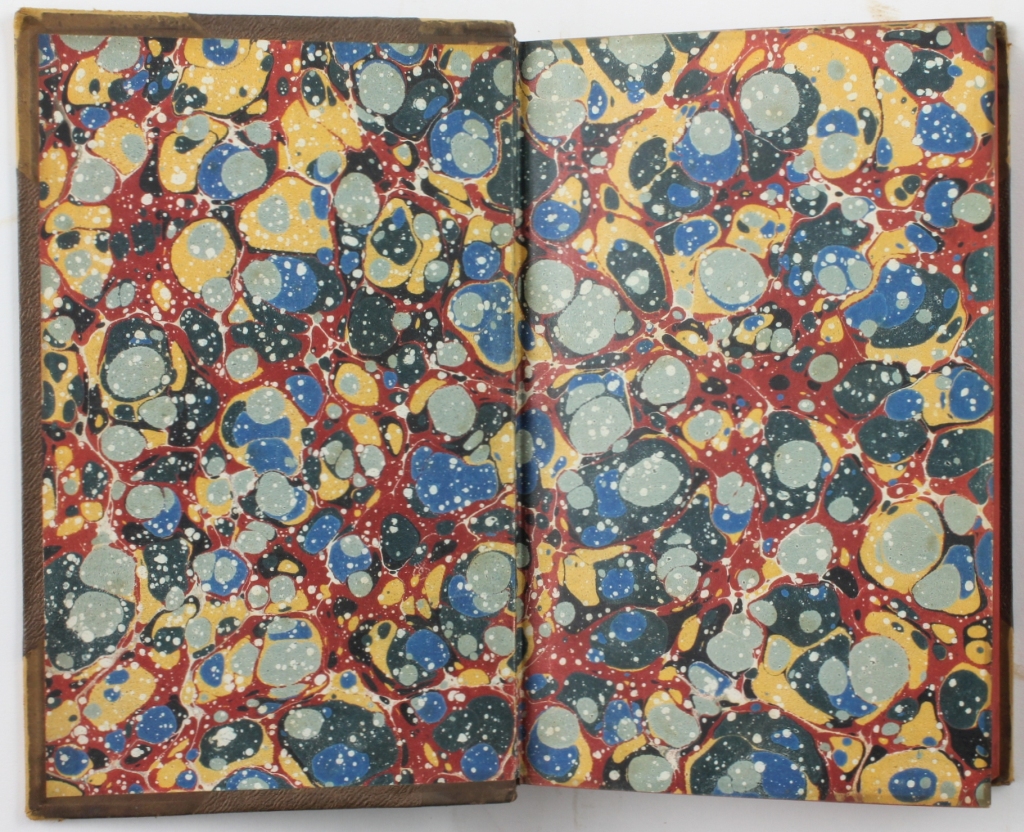
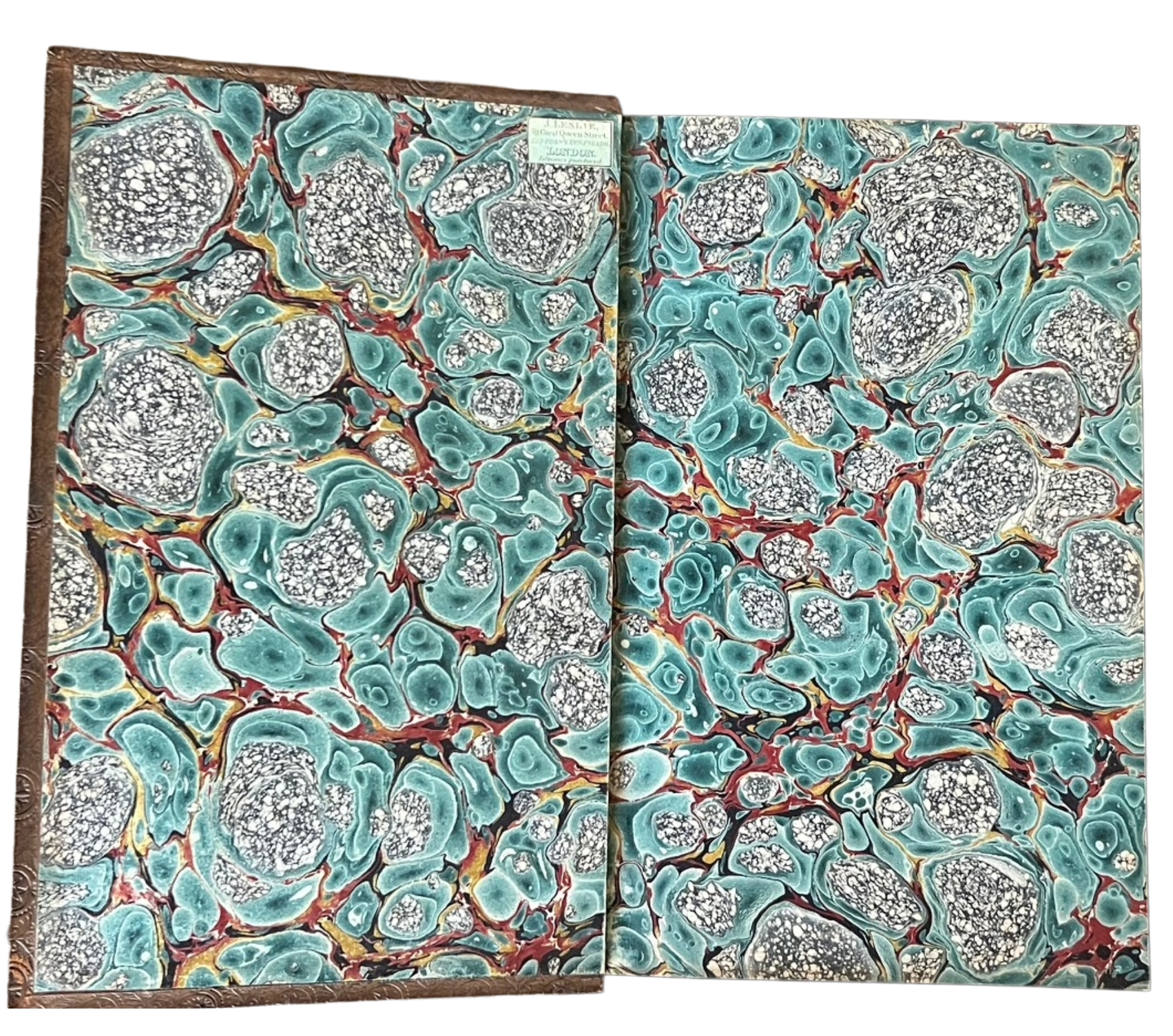
The two books on displays show two different patterns.
The first pattern is a French Shell pattern. It is created by dropping coloured ink, mixed with ox gall, into the size.
Then drops of ink, mixed with some oil, are added. This will drive the other inks into veins, while the oil will create a small white outline.
The second pattern is a Stormont on Shell, a mixed pattern. To a Shell pattern, drops of ink mixed with a dispersant, such as turpentine, are added to the existing pattern. These colours form a large network of holes.
Quinti Septimii Florentis Tertulliani Opera Quae Supersunt Omnia
Franciscus Oehler
1853
P001177229
History of England, from the peace of Utrecht to the peace of Versailles
Philip Henry Stanhope
London, 1854
P001149136
Over a thousand British and Irish women writers published their work in the 18th century. They even outnumbered male authors in a significant number of genres.
Women authors wrote all kinds of literary works: novels, poetry, literary criticism, scientific works, political pamphlets and political satire, travel accounts, cookery books, theology and many more.
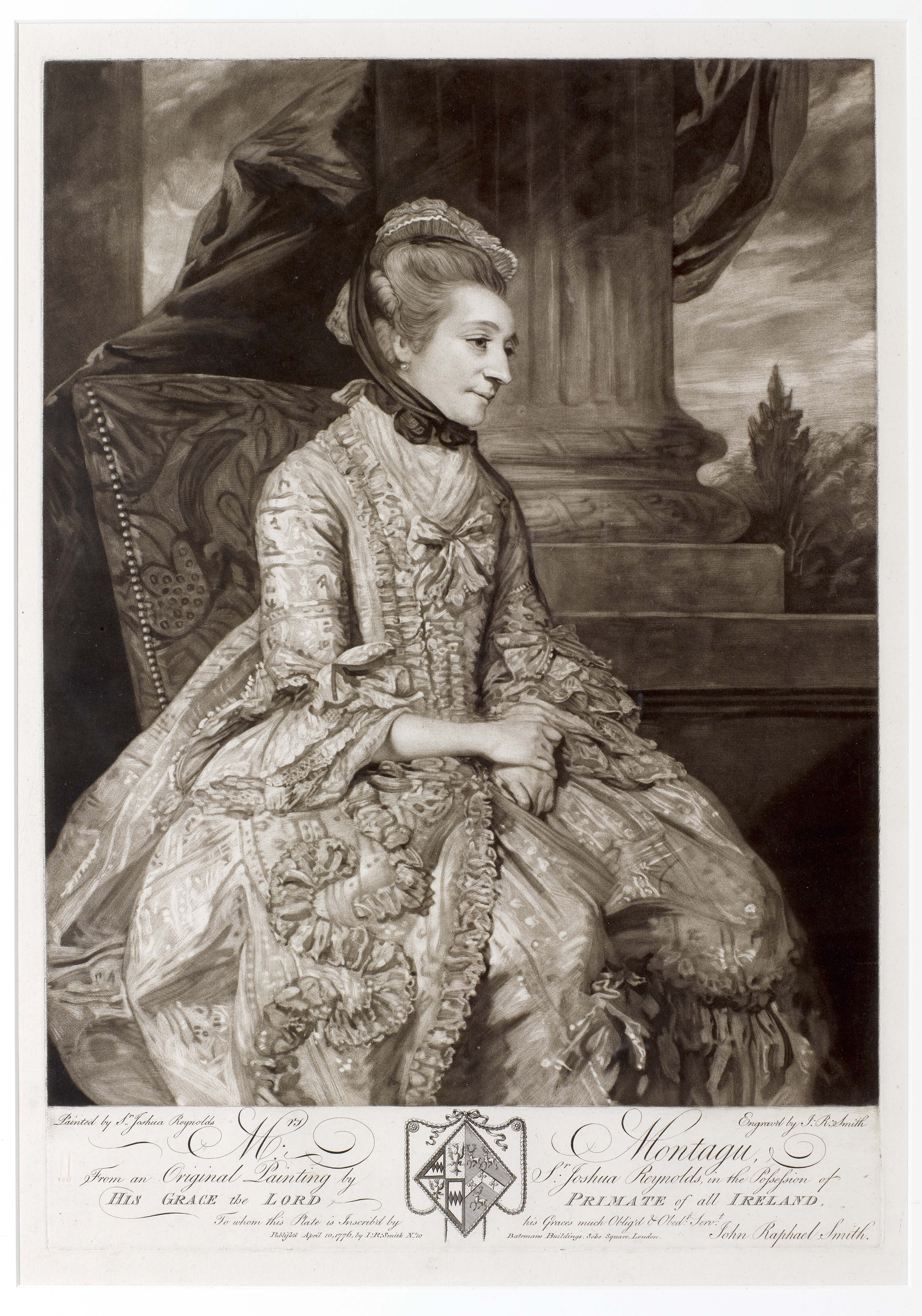
In the middle of the 18th century a group of educated and intellectual women founded the Bluestocking Society. They met at literary salons, led by hostess and literary critic Elizabeth Montagu, cousin of the Library’s founder Archbishop Robinson.
On display is Montagu’s Essay on Writings and Genius of Shakespeare. In this work Montagu defends Shakespeare against criticisms, especially those by the French writer Voltaire. She considers Shakespeare to be the best dramatist of all, and a genius.
The first three editions were published anonymously: her name was not added until the fourth edition in 1777.
![An Essay on the Writings and Genius of Shakespear [sic], Compared with the Greek and French Dramatic Poets. With Some Remarks Upon the Misrepresentations of Mons. de Voltaire, title page](https://armaghrobinsonlibrary.co.uk/wp-content/uploads/2020/06/GeniusShakespear_title-scaled.jpg "An Essay on the Writings and Genius of Shakespear [sic], Compared with the Greek and French Dramatic Poets. With Some Remarks Upon the Misrepresentations of Mons. de Voltaire, title page")
![An Essay on the Writings and Genius of Shakespear [sic], Compared with the Greek and French Dramatic Poets. With Some Remarks Upon the Misrepresentations of Mons. de Voltaire, page 282](https://armaghrobinsonlibrary.co.uk/wp-content/uploads/2020/06/GeniusShakespeare_282-scaled.jpg "An Essay on the Writings and Genius of Shakespear [sic], Compared with the Greek and French Dramatic Poets. With Some Remarks Upon the Misrepresentations of Mons. de Voltaire, page 282")
Portrait of Mrs Montagu, née Robinson
John Raphael Smith (1752 – 1812), Joshua Reynolds (1732 – 1792)
1766
P001907960
An Essay on the Writings and Genius of Shakespear [sic], Compared with the Greek and French Dramatic Poets. With Some Remarks Upon the Misrepresentations of Mons. de Voltaire
Elizabeth Montagu, 1772
P001374555
2017 | Gems and Gem Literature
The founder of the Library, Archbishop Richard Robinson, was a keen collector of James Tassie’s gem impressions.
Tassie had developed a way to make impressions of gemstones in plaster and coloured paste. This process made it possible for less wealthy collectors to collect gems.
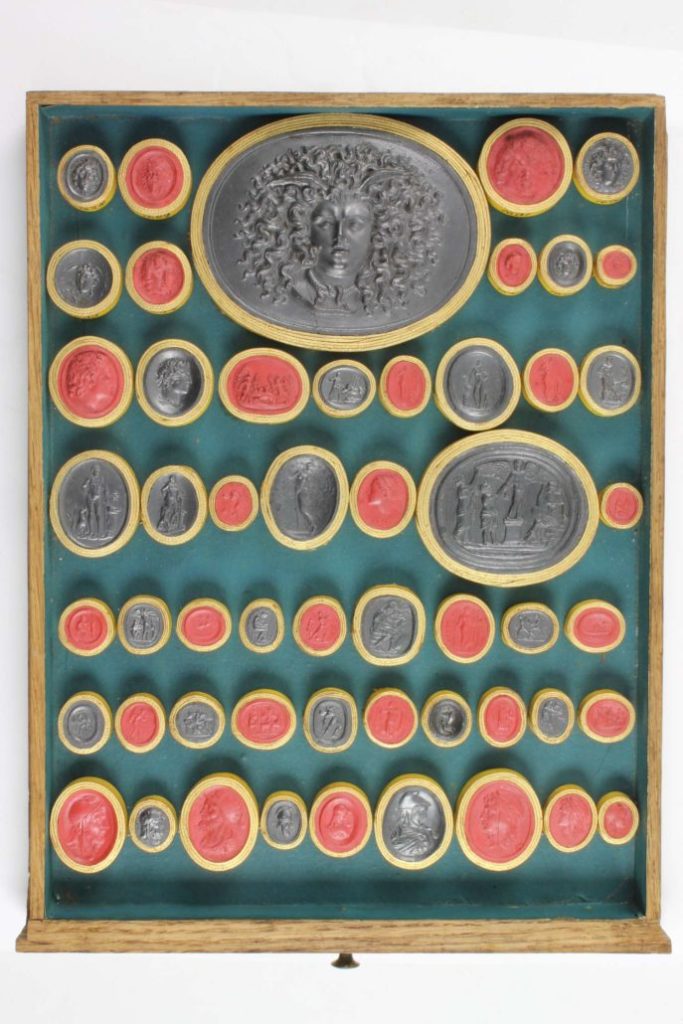
Robinson left his collection of almost 4,000 gems, including 3100 Tassie gems, to the Library. They are stored in drawers in the central cabinet below the Robinson bust.
In the drawer on display there is a large striking depiction of Medusa, a figure in Greek mythology.
Medusa was one of the three Gorgon sisters: powerful, winged demons. She is recognisable by having snakes for hair.
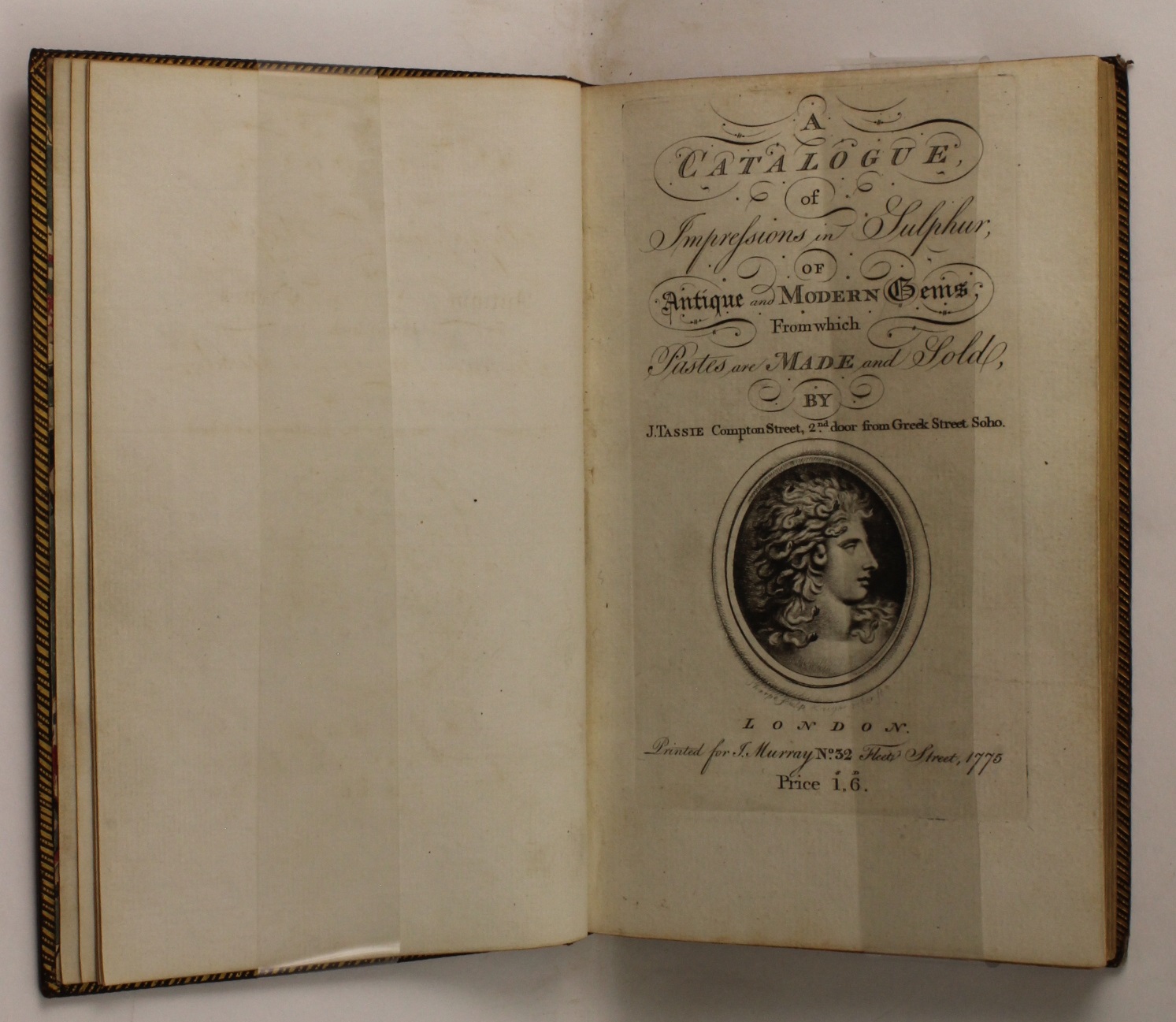
The Tassie Catalogue is open on the page where the Medusa gem, and the gems surrounding it, are described.
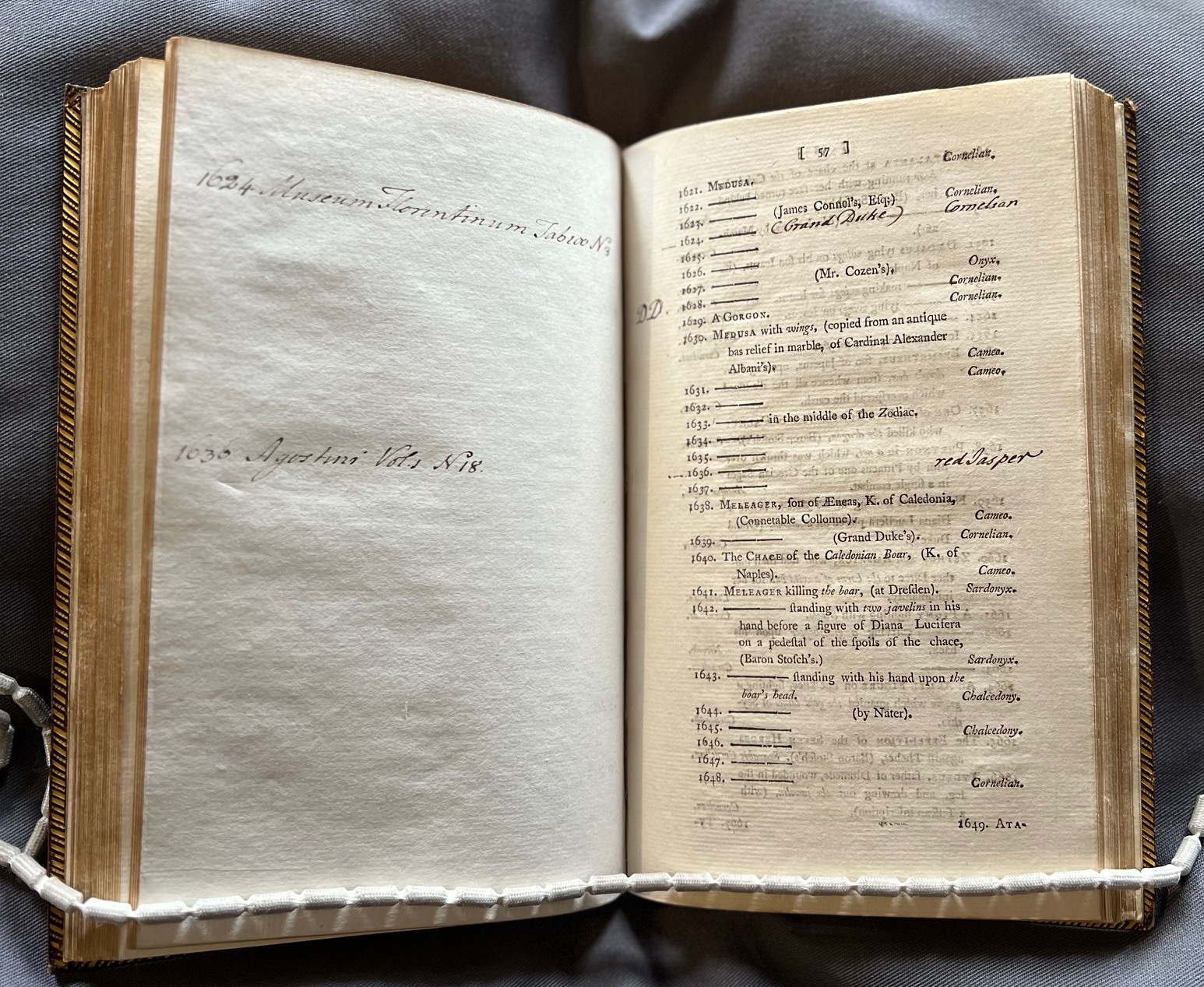
Gem Drawer DD
James Tassie
A Catalogue of Impressions in Sulphur of Antique and Modern Gems From Which Pastes are Made and Sold, by J. Tassie Compton Street
James Tassie, 1775
P001962929
2017 | Women Writers in the 18th Century
In 1748 Maria Agnesi published Instituzioni Analytiche, ad Uso della Gioventù Italiana, a work to explain differential and integral calculus.
Agnesi was made Honorary Professor of Maths and Natural Philosophy in the University of Bologna in 1749 . She was only the second woman to hold a university chair in Europe.
On display is a 1775 French edition of the work.
In the 1801 English translation, she urged women
to forget games of whist, quadrille, back-gammon, and all other games of chance and to take up analytics.
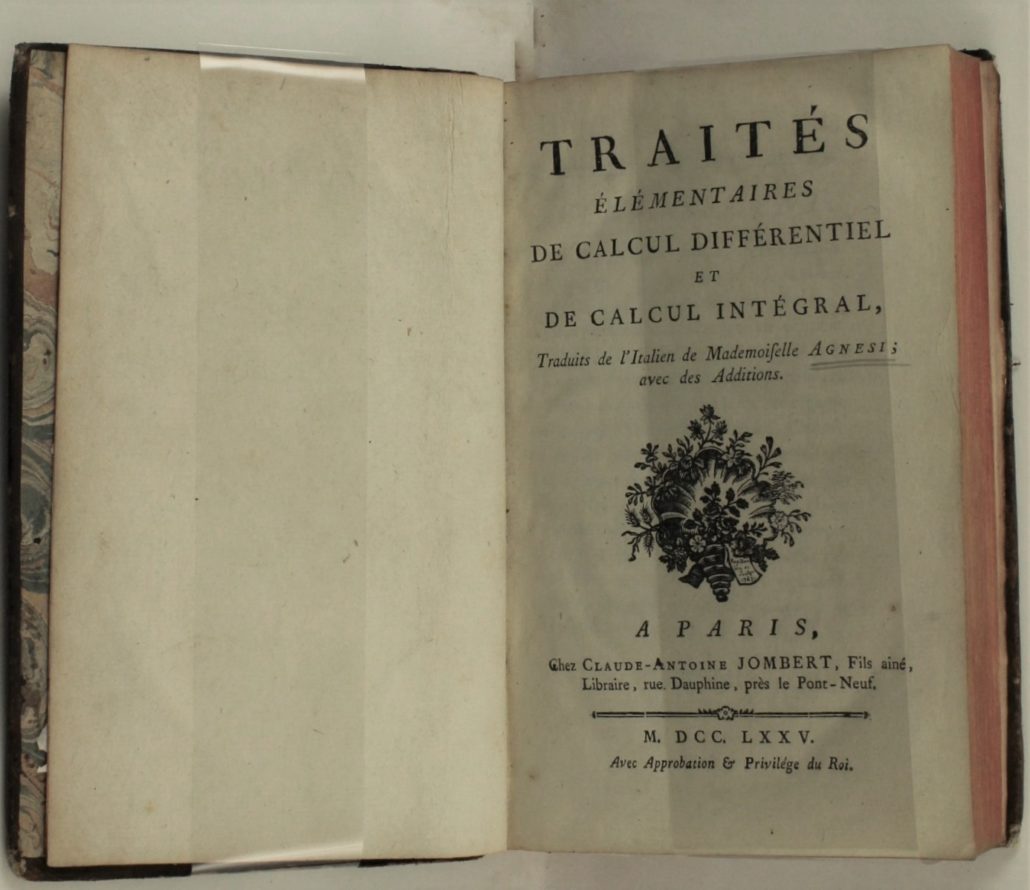
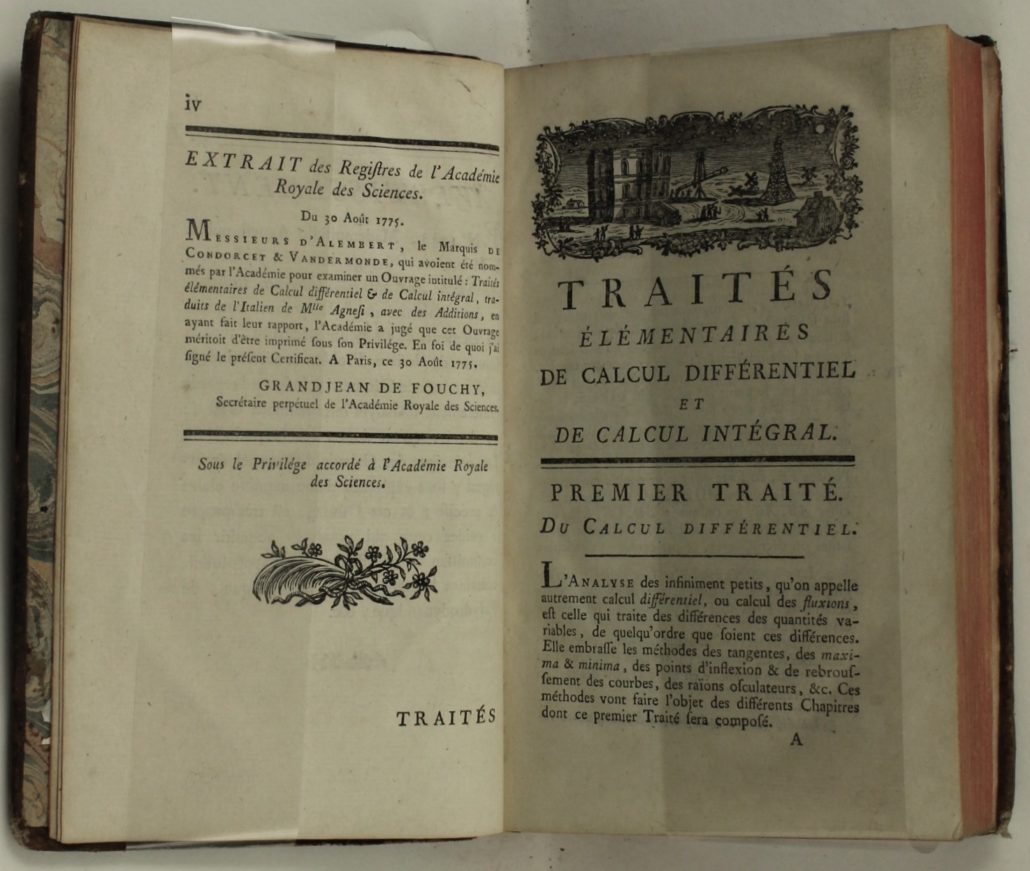
Traités Elémentaires De Calcul Differentiel Et De Calcul Integral
Maria Agnesi
1775
P001144835
2017 | Mapping History
The library collections holds some atlases and maps of international importance. They covering areas as wide as the entire world, and as small as local townlands.
The 1835 Ordnance Survey maps of the whole of Ireland are a huge draw for local and family historians.
The map on display accompanied the first complete modern geography, which was first published in 1624. This edition is from 1697.
The author, Philipp Clüver, is considered the founder of historical geography. This is the study of an area at a specific time in the past,and the geographic changes there over a period of time. Prior to Clüver, geographers would study the area by reading classical texts. Clüver was the first to travel and inspect the relevant areas in person.
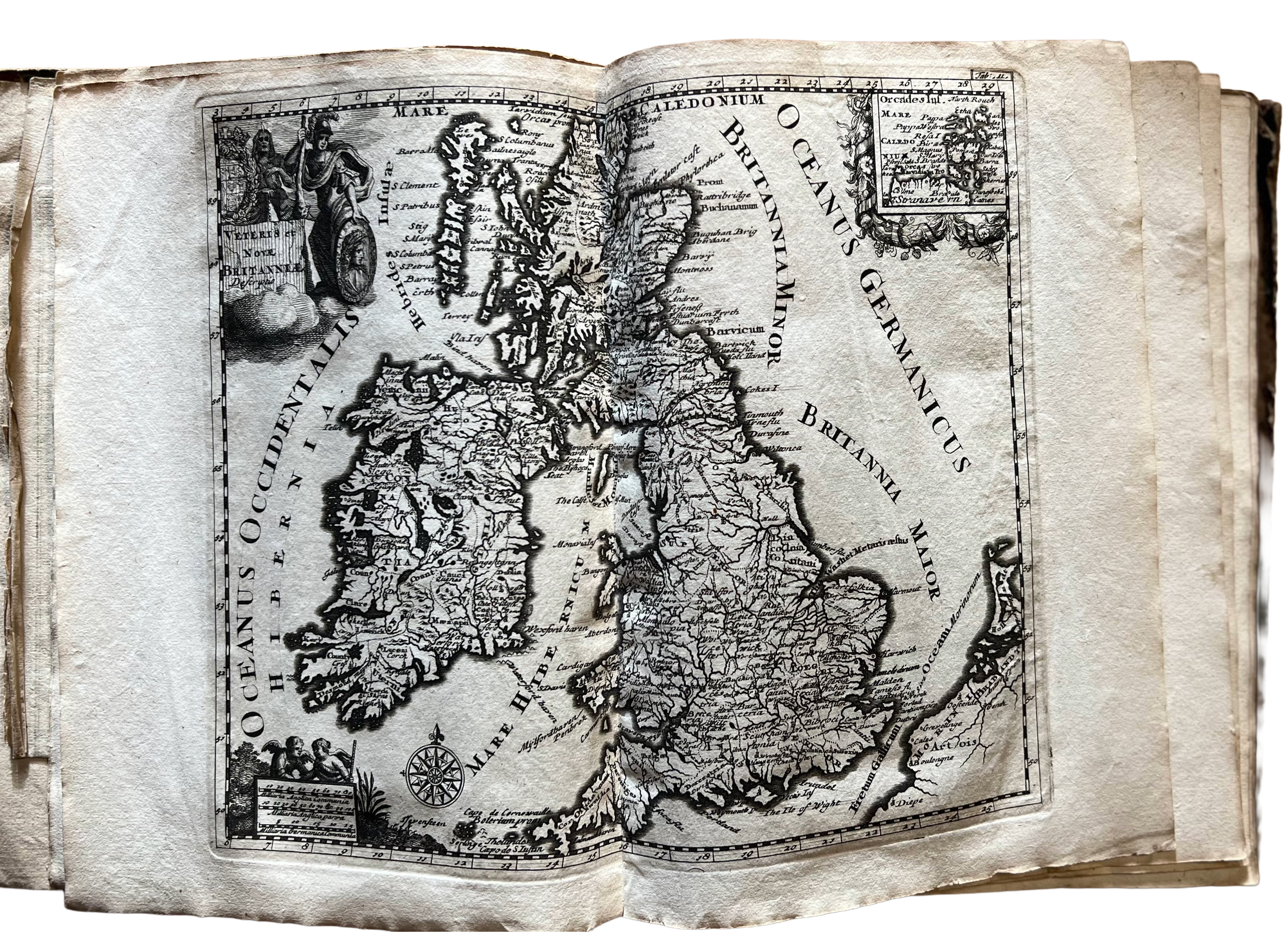
Collection of maps of the world only, for the publication Philippi Cluverii Introductio in universam geographiam tam veterem quam novam tabulis geographicis XLVI. ac Notis olim ornata à Johanne Bunone, Jam vero locupletata additamentis & annotationibus Joh. Frid. Hekelii & Joh. Reiskii. Cum privilegio Ordinum Holl. & Westfrisiae
Philipp Clüver, Author
Amsterdam/London, 1697
P001533378
Isaac Newton was a mathematician and physicist, wholaid the foundations of classical mechanics. He worked out the laws of motion and universal gravitation.
On display is Newton’s Philosophiae Naturalis Principia Mathematica. In it, Newton gives definitions of concepts such as force, momentum and mass, as well as the laws of motion.
First published in 1687, this work brought Newton international fame. He is universally recognised as one of the most influential scientists.
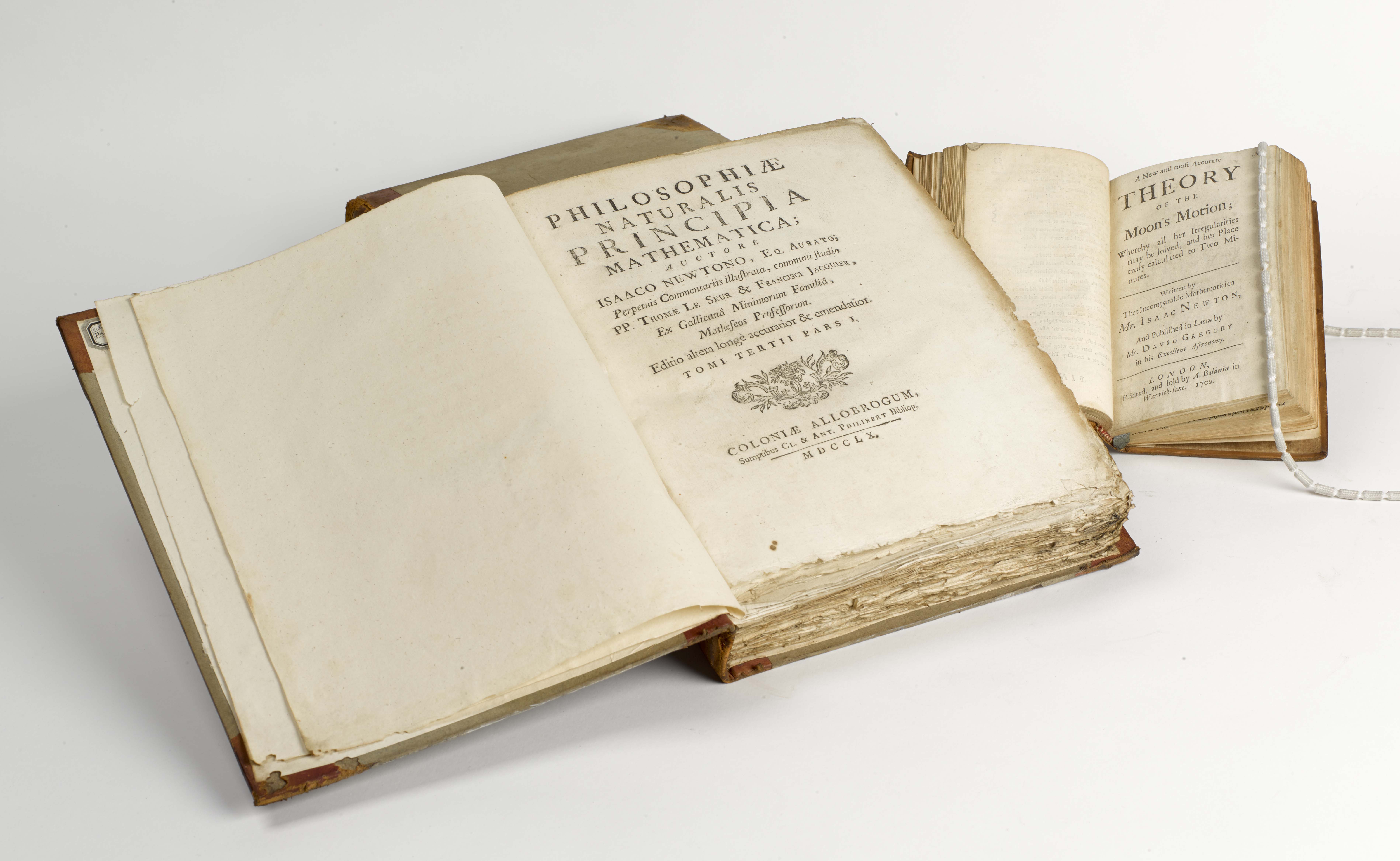
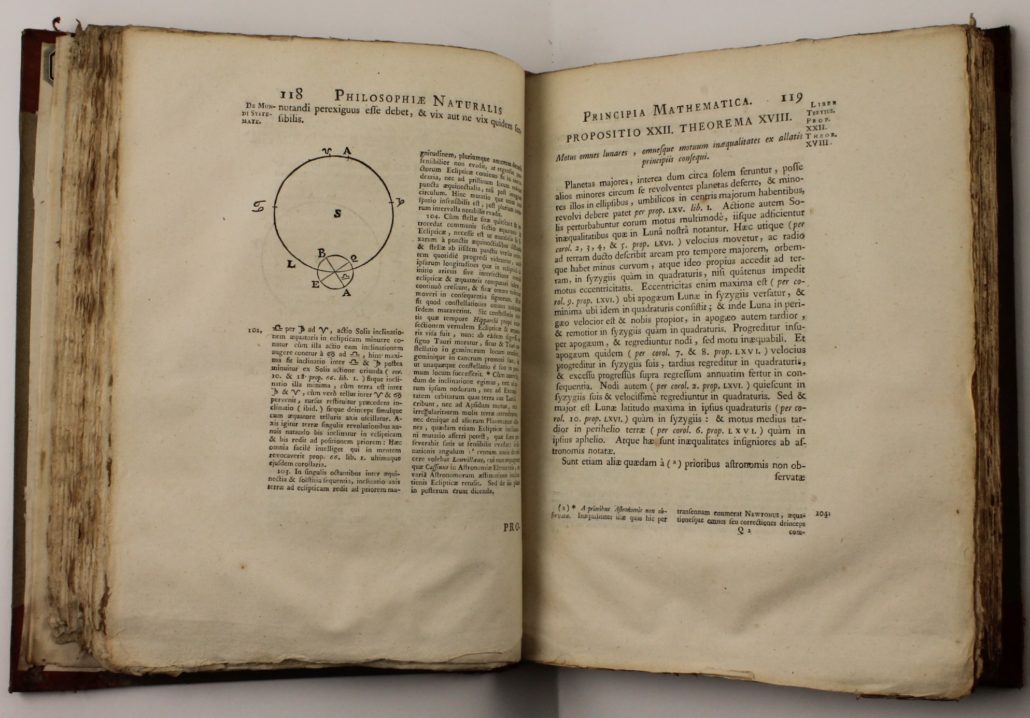
Philosophiae Naturalis Principia Mathematica
Isaac Newton, Author
Geneva, 1760
P001144118
2020 | Botany
Joseph Paxton was head gardener for the Duke of Cavendish. In this role Paxton cultivated a particular type of banana in the greenhouses of Chatsworth House. He named the plant Musa cavendishii, after his employer. Since the 1950s this banana is the most commonly traded banana in the world.
From around 1830 Paxton started working on botanical publications. The periodical Magazine of Botany was his third venture.
It contains the descriptions of new and uncommon plants grown in British gardens. Many descriptions are accompanied by colour illustrations by F.W. Smith.
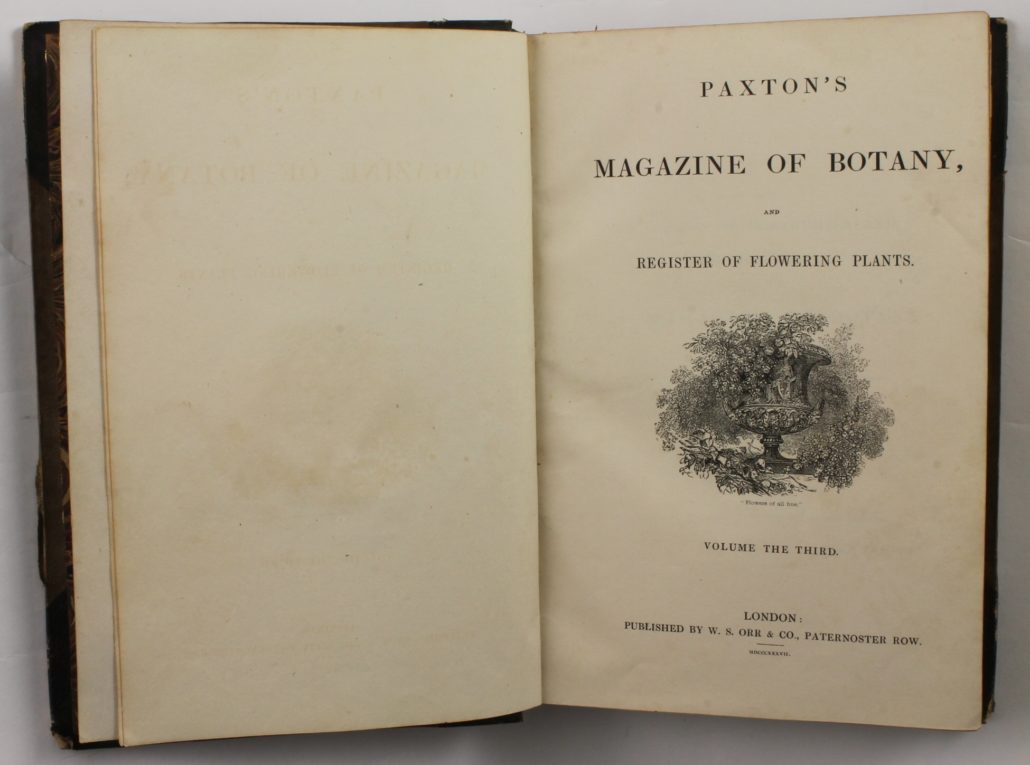
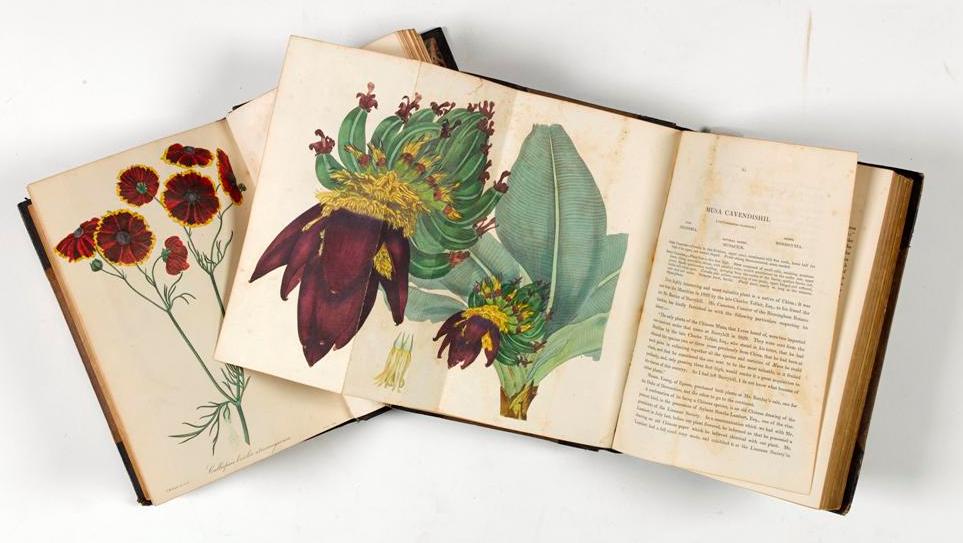
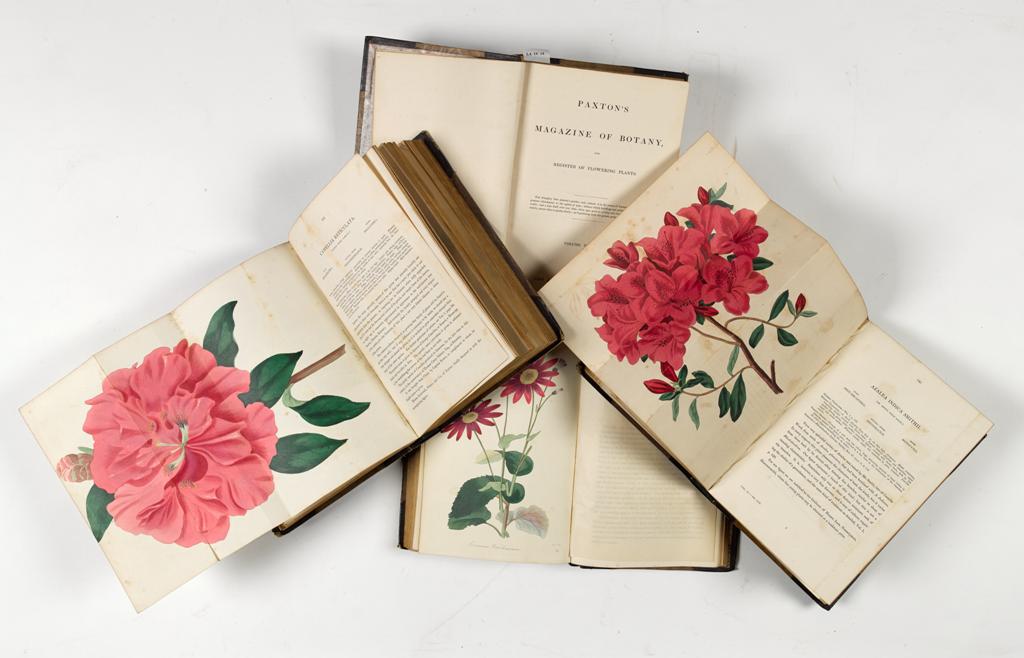
Paxton’s Magazine of Botany, and Register of Flowering Plants
Joseph Paxton
London, 1834
P00246910x
2021 | If speaking is silver, then listening is gold
An Exhibition on Gold and Silver
Armagh Robinson Library was built in 1771.
It was established as a public library, and the Library was known as ‘Armagh Public Library’ until 2017. In that year the Library was rebranded Armagh Robinson Library, in honour of its founder.
The silver medal on display was commissioned to commemorate the opening of the Library in 1771.
The original facade of the Library with its three bay windows is shown on the reverse. The bust of Archbishop Richard Robinson is displayed on the obverse.
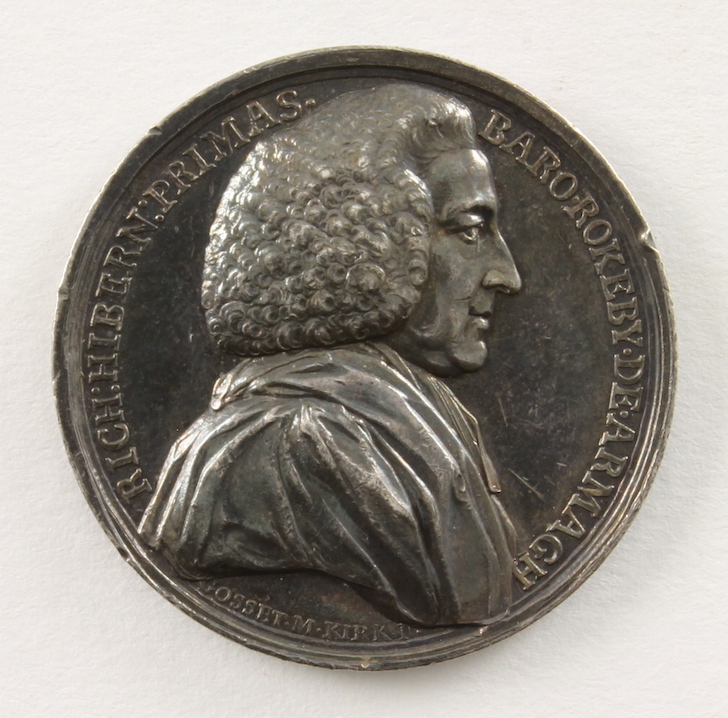
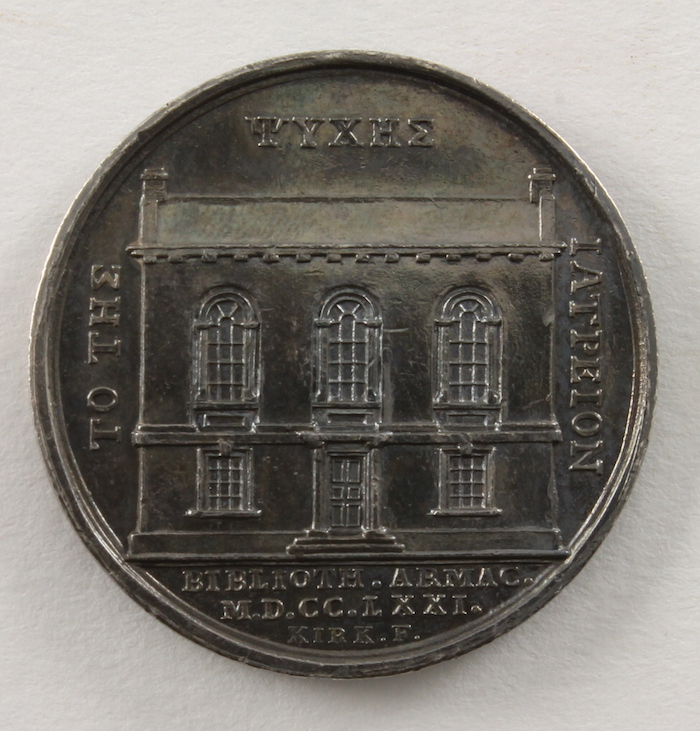
Commemorative medal for the opening of the Armagh Public Library in 1771
John Kirk, Manufacturer; Isaac Gosset, Artist
1771
2020.1
Purchased with support from the NI Museums Council and Esmé Mitchell Trust
2022 | Archbishop Richard Robinson, 1708 – 1794
The Founder of the Library, Archbishop Richard Robinson, had a list of all the inhabitants of Armagh compiled in 1770. This list is now commonly known as the Census of the City of Armagh for 1770 and is held in the Library’s collection.
From 1770 onwards, Robinson initiated eleven new building works and one renovation project in Armagh.
The page on display shows the citizens who lived in Scotch Street, including a carpenter, smith and glazier.
We wonder if the census proved helpful in finding Armagh citizens trained and experienced in the building trade!
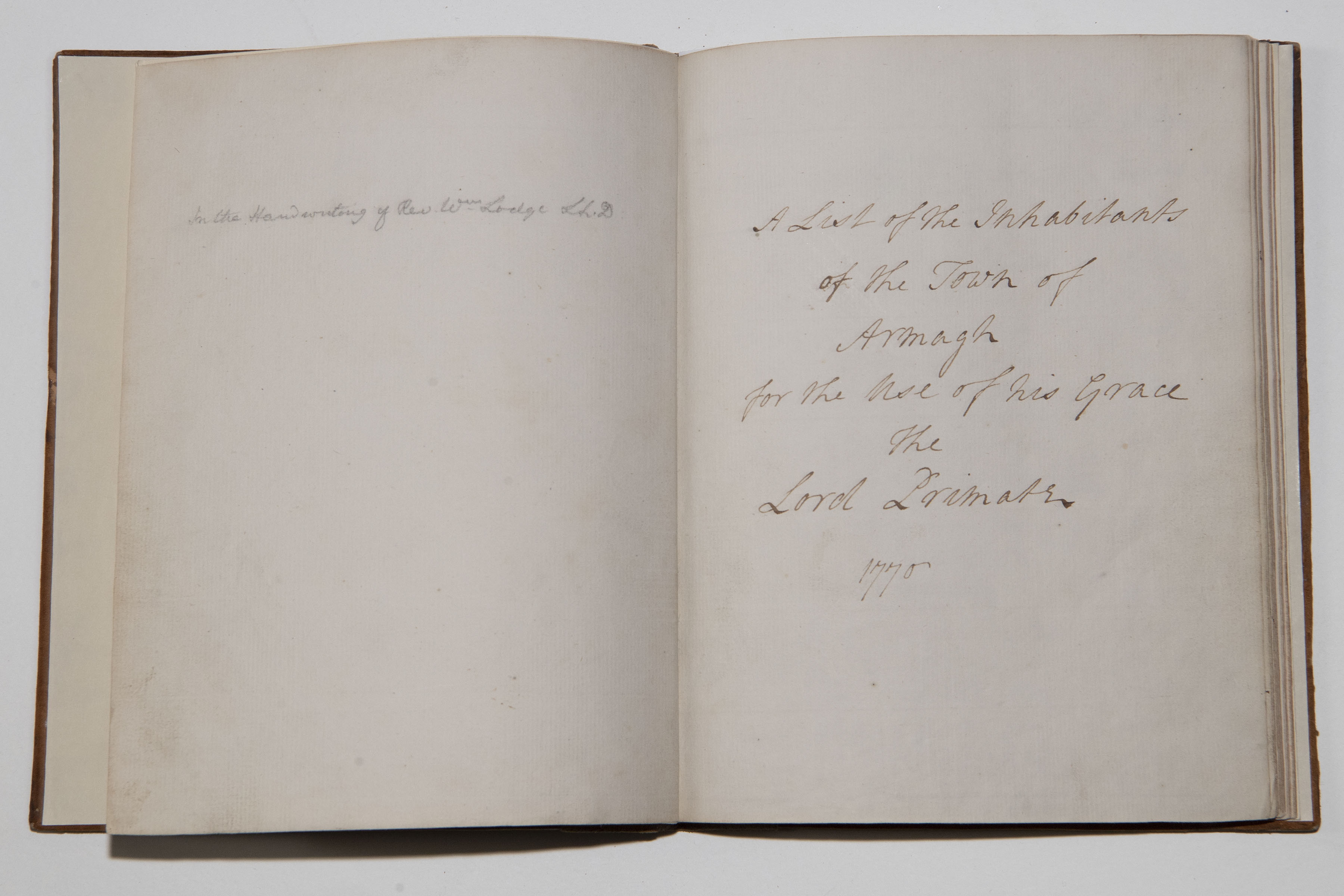
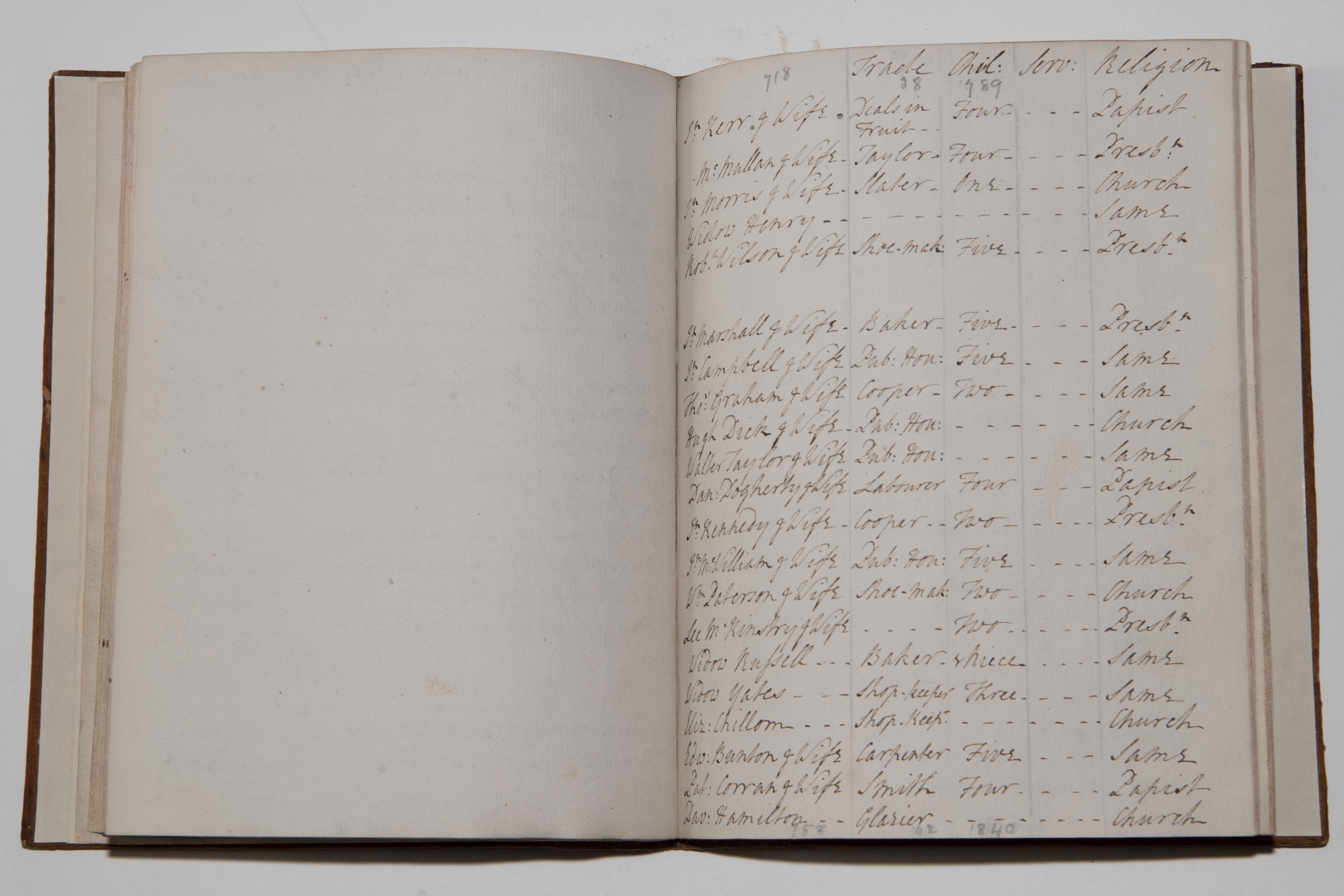
List of the Inhabitants of the Town of Armagh for the Use of His Grace, the Lord Primate.
William Lodge, 1770
P002384481
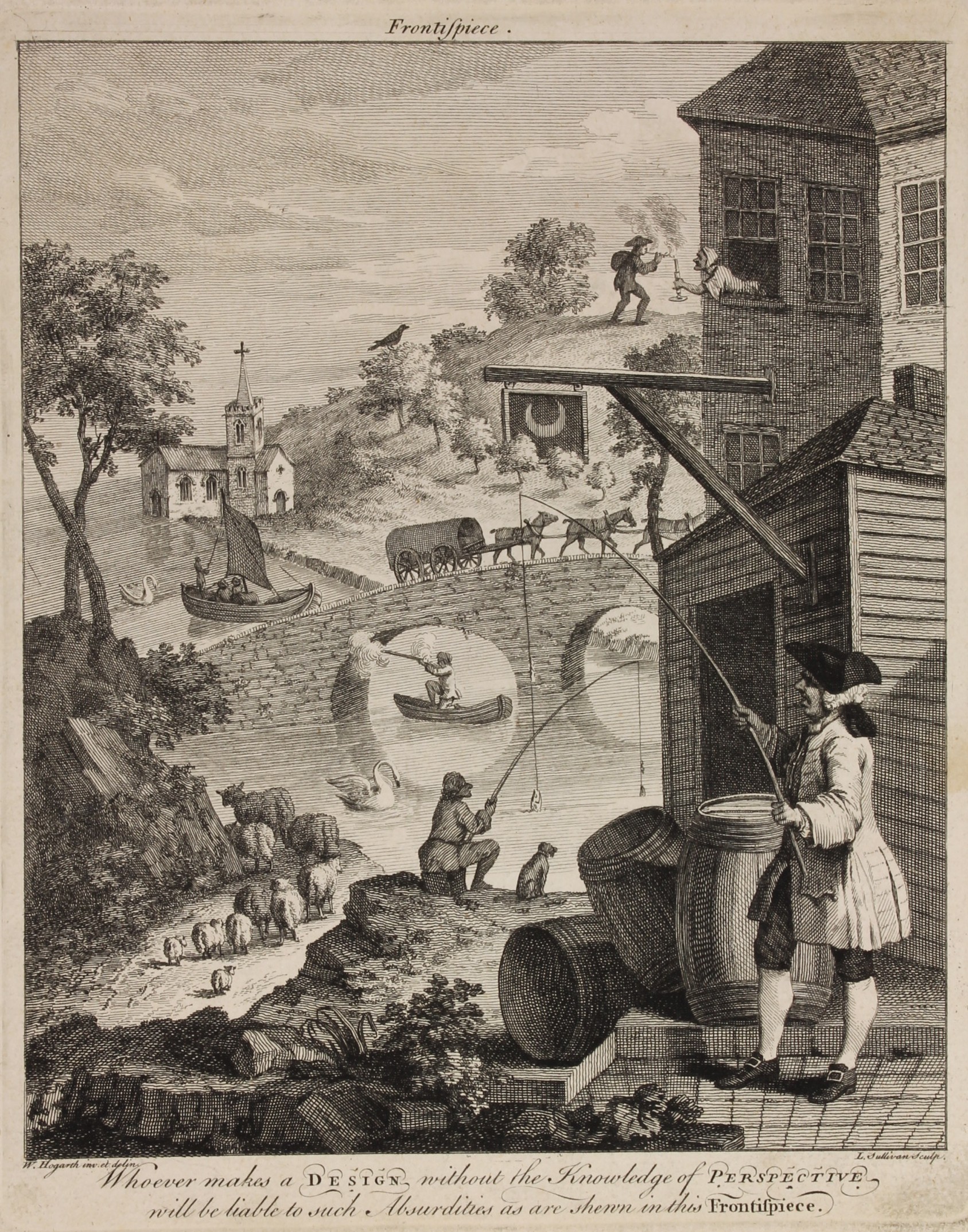
2023 | The Rokeby Print Collection
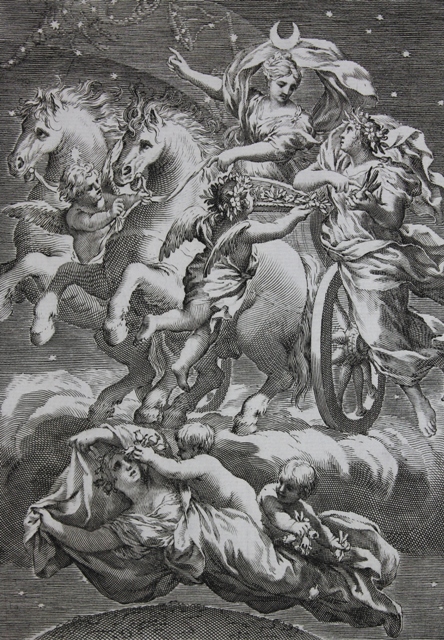
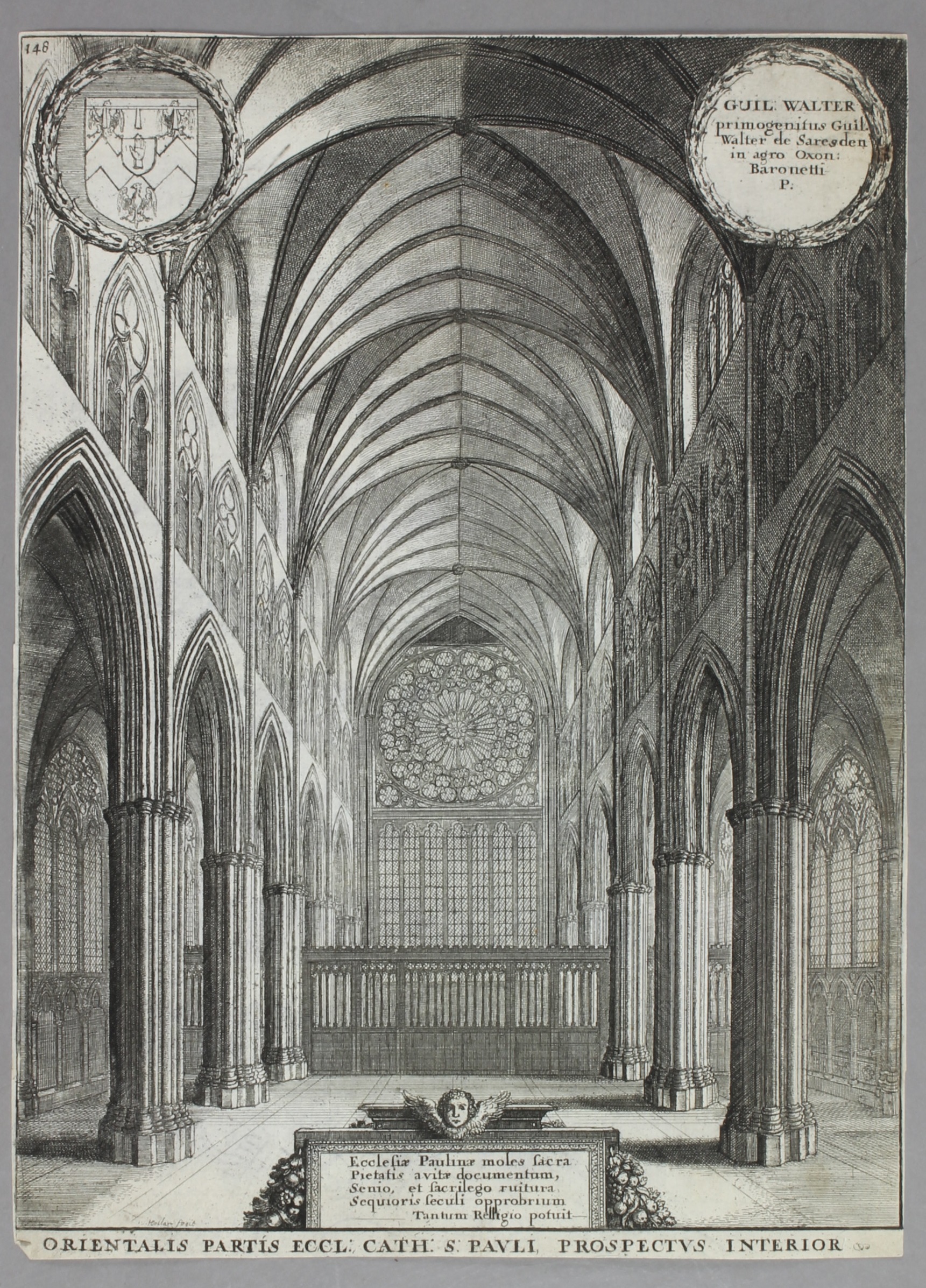
The Rokeby Print Collection at the Library is deemed to be one of the great art collections in Northern Ireland.
The collection was left to the Library by, and named after its founder Archbishop Richard Robinson.
It is an extremely rare example of an intact eighteenth-century print collection. It contains over 4,400 prints, including masterpieces of printmaking produced across Europe between the sixteenth and eighteenth centuries.
On display some examples by leading 17th and 18th century engravers:
- Wenceslaus Hollar (1607-1677)
- Claude Mellan (1598 – 1688)
- William Hogarth (1697-1764
2015-2025 | Semi-Permanent Exhibition
Book of hours
A Book of Hours is a prayer book for non-clergy in late medieval Europe and was used for private devotion.
It was often personalised and illuminated with miniature paintings depicting the life of Christ, the Virgin Mary, and individual saints.
The text includes a calendar of church feast days and a series of prayers to be said eight times a day.
The text of this Book of Hours was printed, but illuminated by hand.
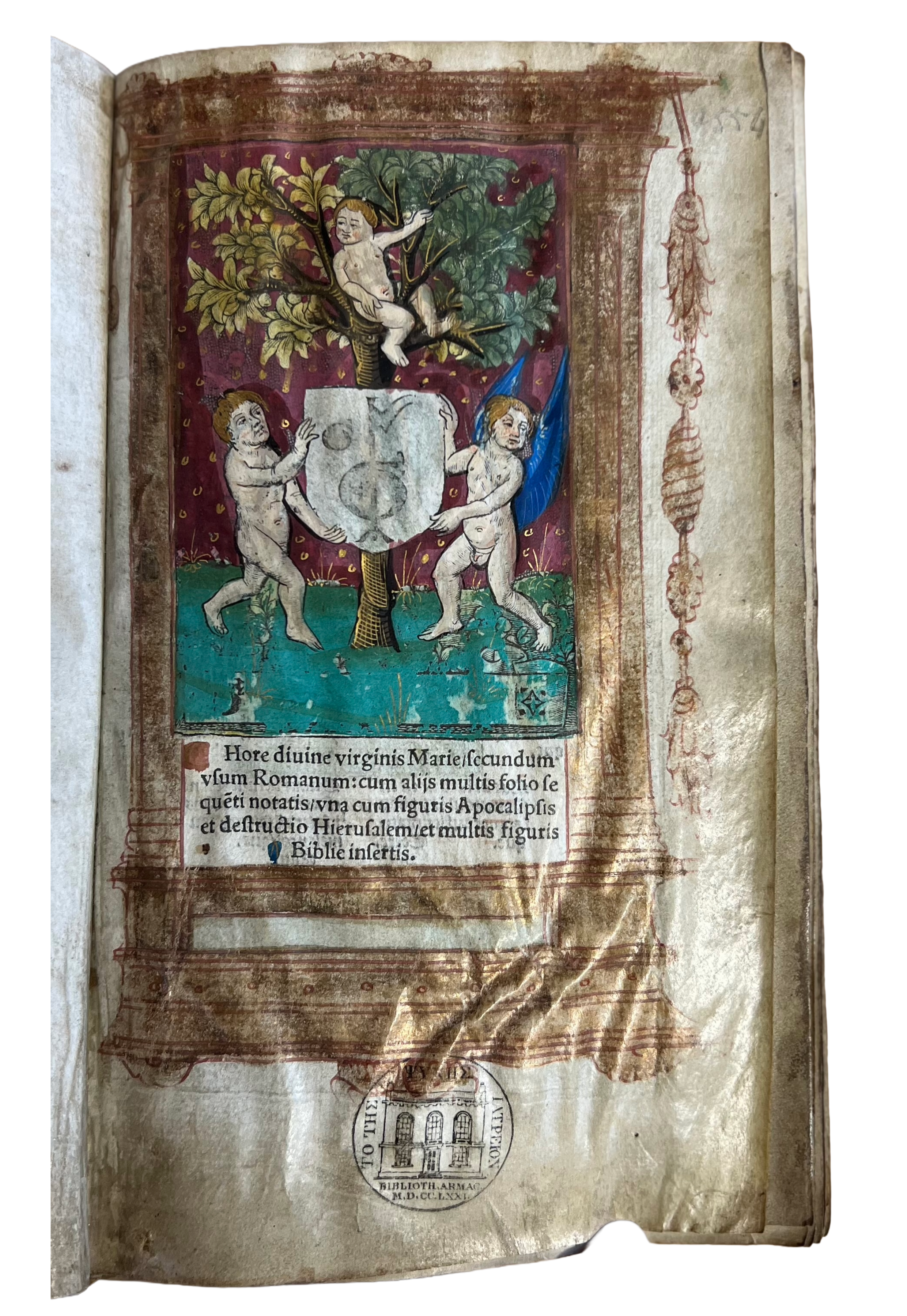
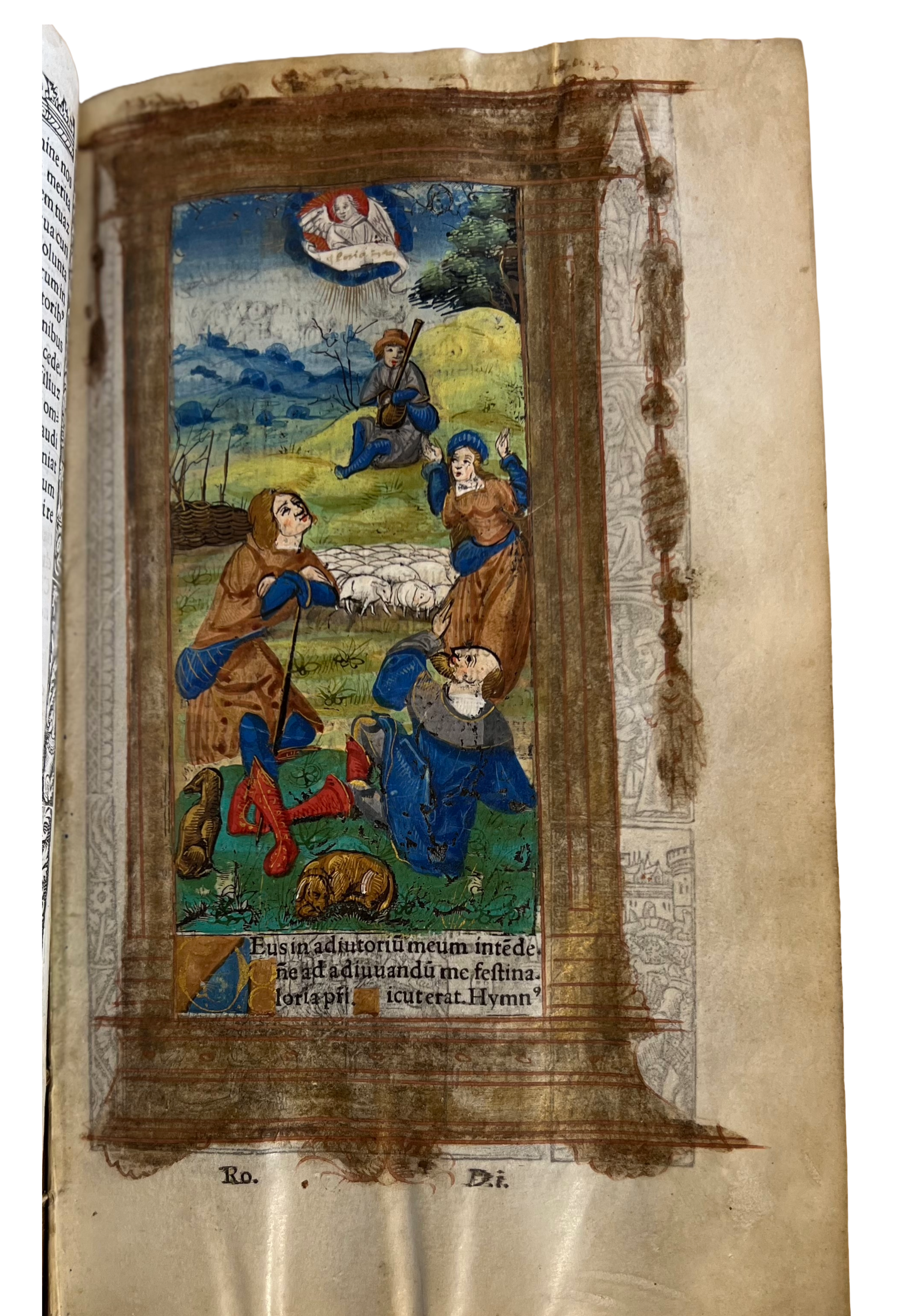
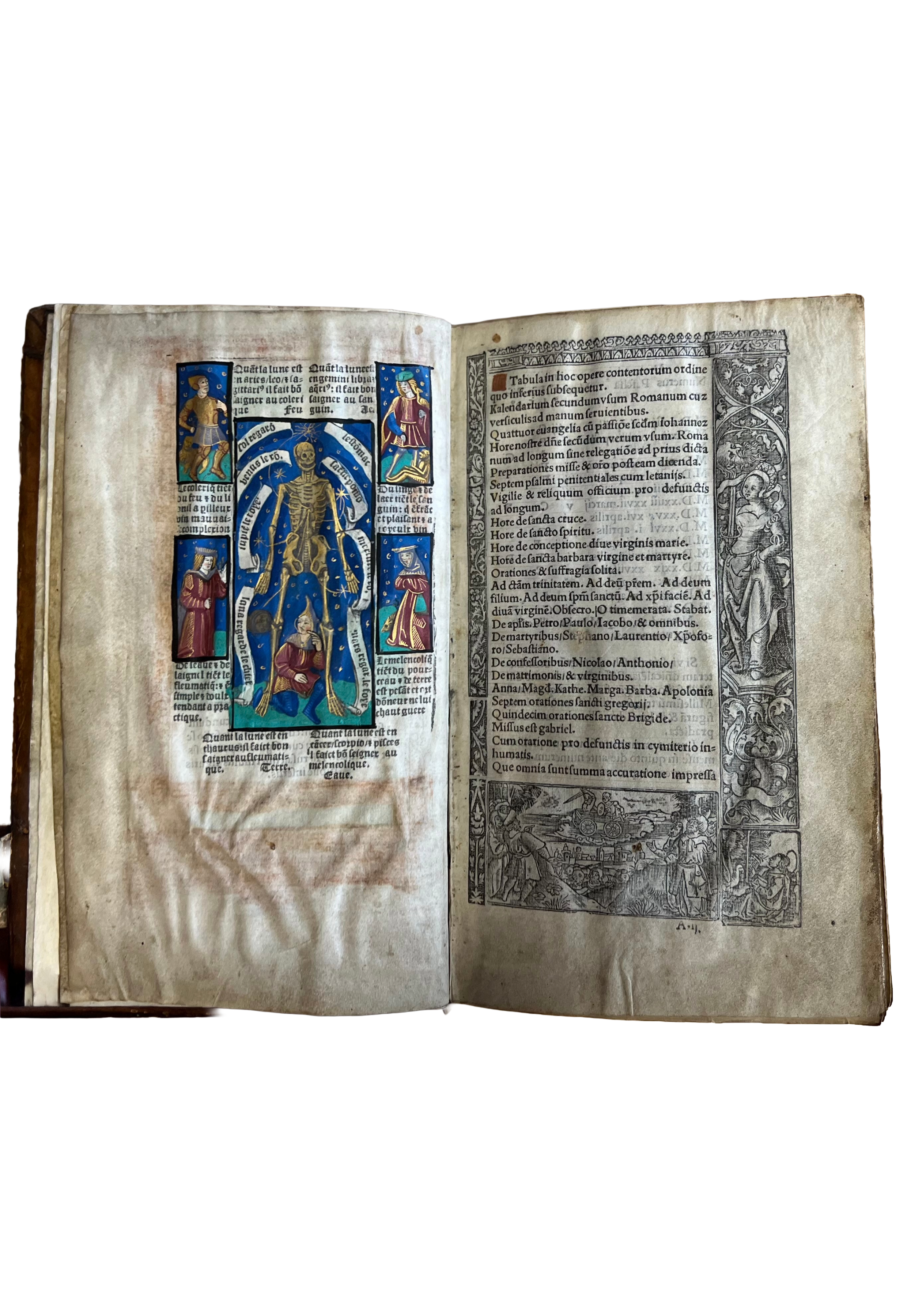
Hore divine virginis Marie secundum usum romanum, cum aliis multis, folio sequenti notatis, una cum figuris apocalipsis et multis figuris Biblie insertis
Gilles Hardouyn, publisher
Paris [±1513]
P001836060
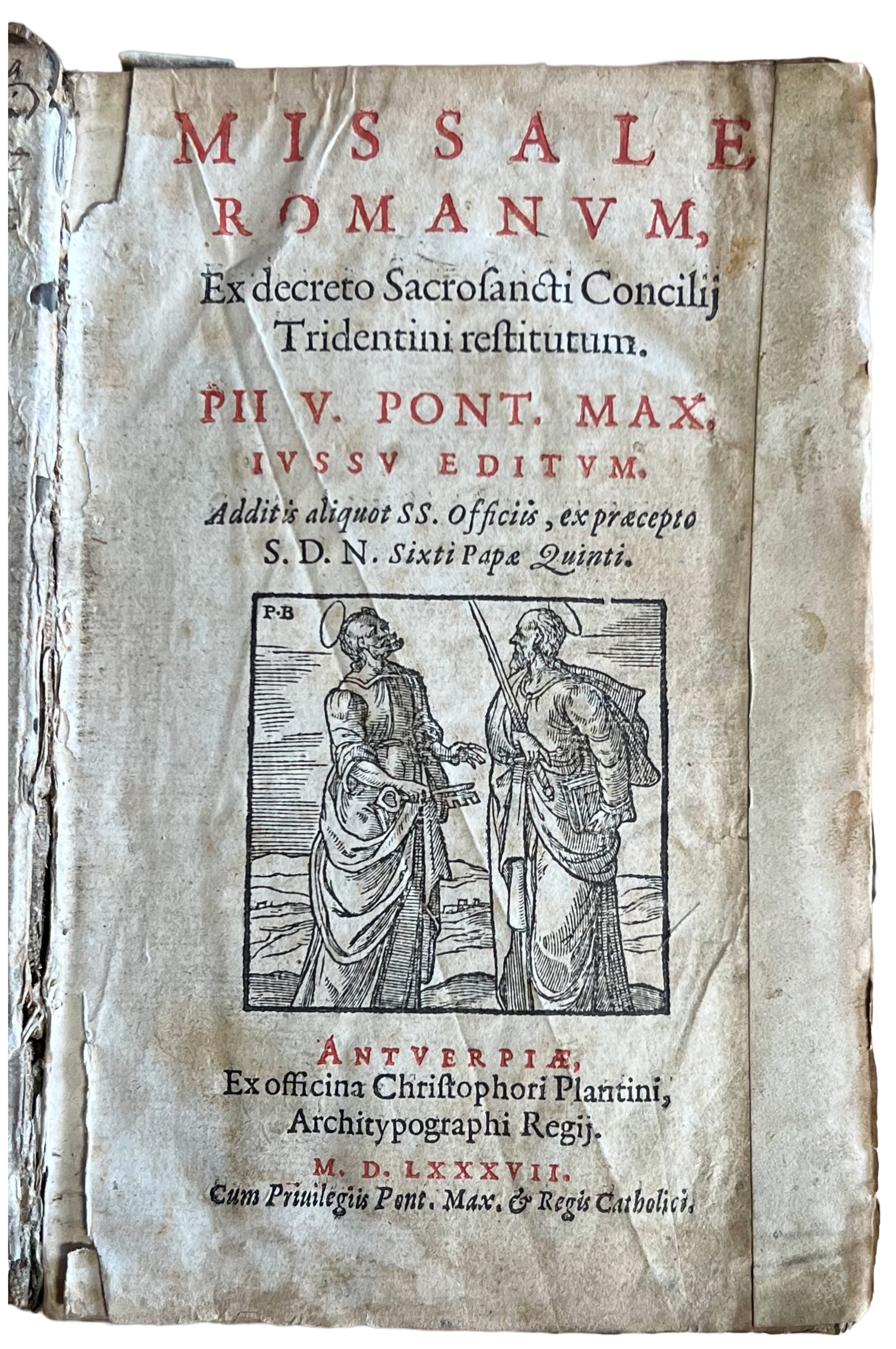
Roman Missal
The Roman Missal, the official liturgical book of the Roman Catholic Church, contains all the prayers, chants, and instructions for the celebration of Mass throughout the liturgical year. It was published by order of Pope Pius V in 1570.
It was written in Ecclesiastical Latin, and was used, with amendments, right up to 1969.
The edition on display was printed by Christopher Plantijn in Antwerp. His printing work were the largest in Europe in the 16th Century.
Missale Romanum, Ex decreto sacrosancti Concilij Tridentini restitutum, PII V. Pont. Max. iussu editum. Additis aliquot SS. Officiis, expraecepto S.D.N. Sixti Papae Quinti
Christopher Plantijn, publisher
Antwerp, 1587
P001836311
Geneva Bible, or, Breeches Bible
The Geneva Bible is one of the most important translations of the Bible into English, preceding the Douay Rheims Bible, and the King James Version.
The edition of the Geneva Bible on display is the only edition that translates Genesis 3:7 “…sewed fig tree leaves together and made themselves breeches.”, rather than the more commonly translation ‘loincloths’.
That is why it is commonly known as the Breeches Bible.
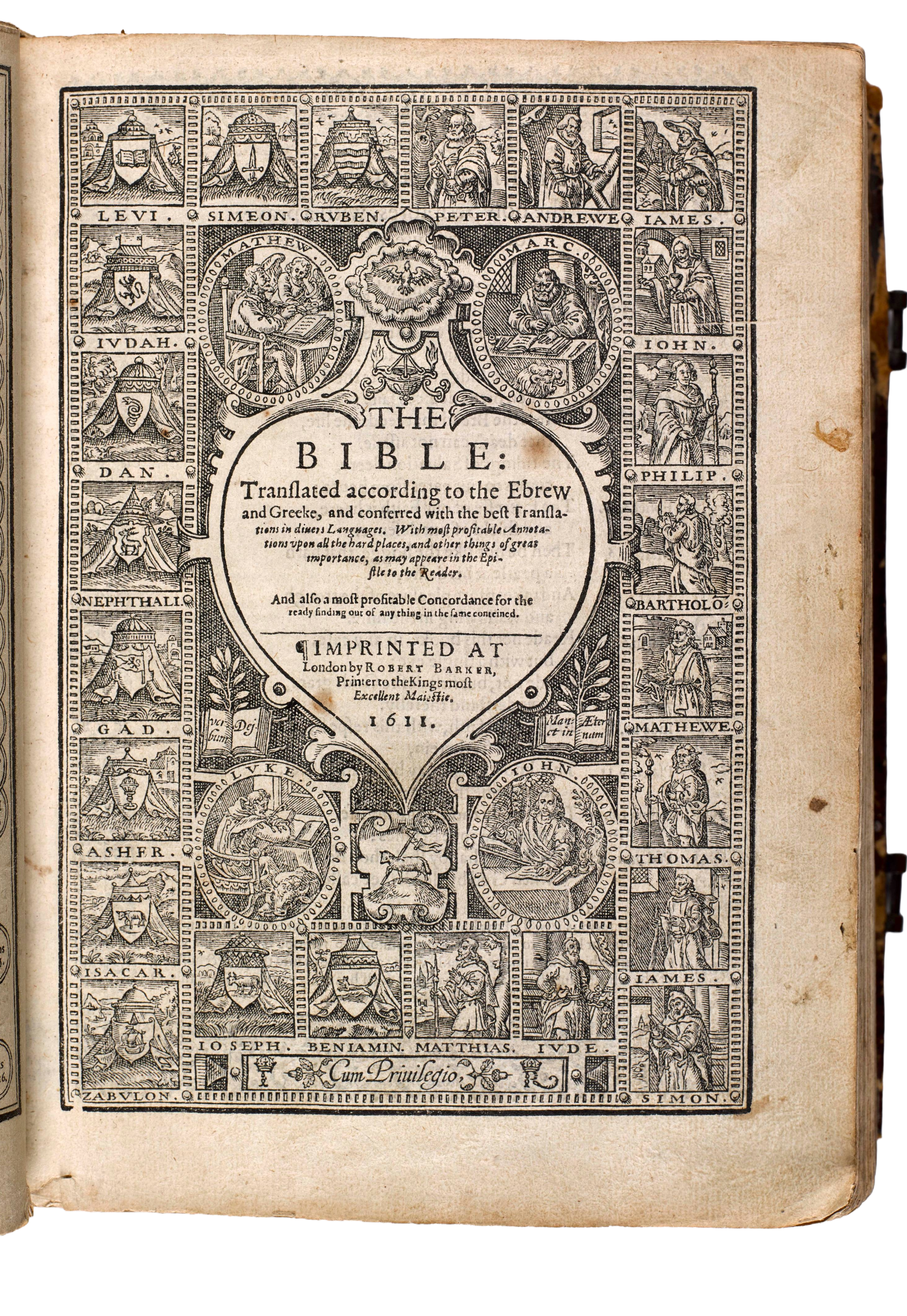
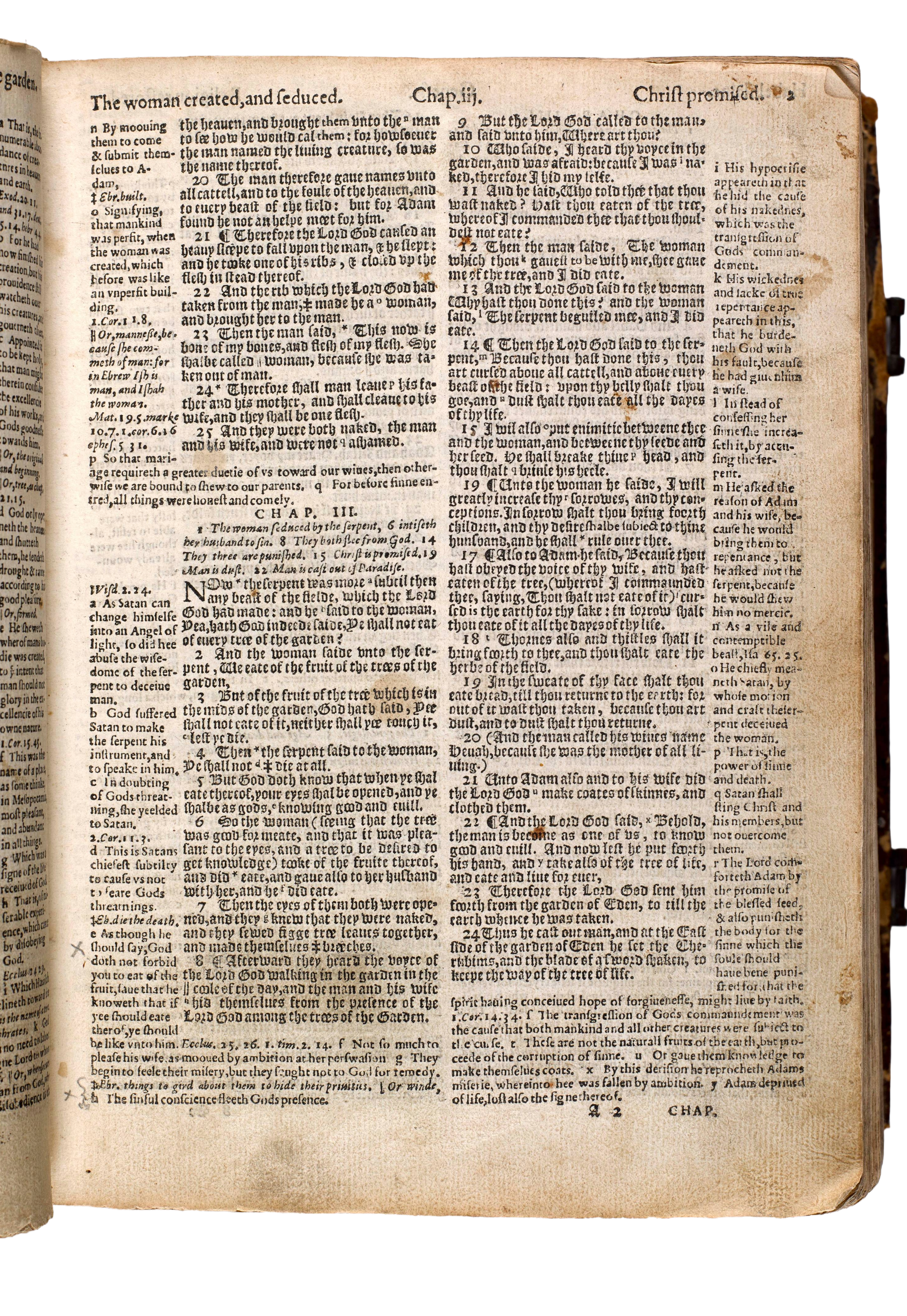
The Bible: translated according to the Ebrew and Greeke, and conferred with the best translations in divers languages. With most profitable annotations upon all the hard places, and other things of great importance, as may appeare in the epistle to the reader. And also a most profitable concordance, for the ready finding out of any thing in the same conteined
Robert Parker, Publisher
London, 1611
P001836052